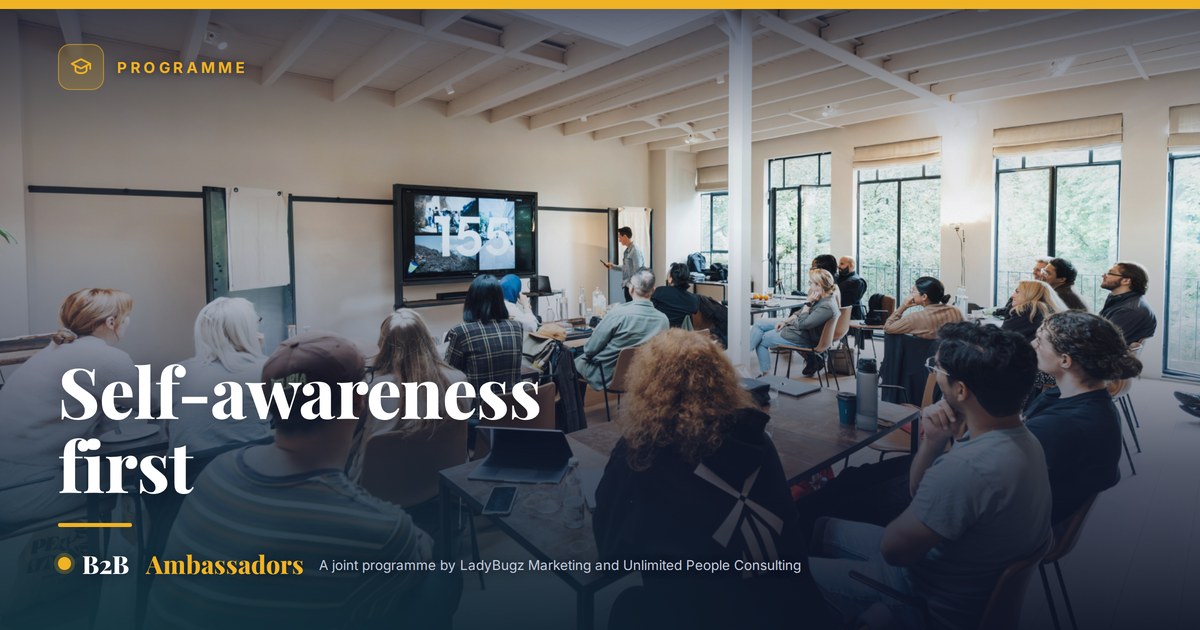
Know Yourself + Show Yourself

Why Does Your Brand Ambassador Programme Fail Without Self-Awareness?

Most advocacy programmes hand people content templates and hope for the best. That is why most advocacy programmes fail.

Why Does Your Brand Ambassador Programme Fail Without Self-Awareness?
Key Insights
  • Tactics-only programmes fail: Employee advocacy programmes that focus exclusively on LinkedIn tactics without addressing the person behind the profile produce scripted, inauthentic content that the 2026 algorithm penalises
  • The two-pillar approach: B2B Ambassadors combines Know Yourself (self-awareness through Lumina assessments) with Show Yourself (digital presence through LinkedIn training) for lasting behaviour change
  • Authenticity is measurable: Hybrid AI + human content scores 23% higher in satisfaction (based on insights from Forrester 2026); content rooted in genuine self-awareness is inherently more human
  • AI detection is rising: 65% of consumers detect AI content within seconds (based on insights from HubSpot 2026); the only sustainable defence is genuinely human voices
  • Self-awareness drives content quality: When people understand their strengths, communication style, and professional values, their content becomes distinctive rather than generic

What Goes Wrong With Tactics-Only Programmes?

The typical brand ambassador programme looks like this: select 10-20 employees, give them a LinkedIn training session, provide content templates, set up a sharing platform, and measure compliance. Six months later, participation has dropped to 20%, the content is indistinguishable from company marketing, and leadership questions the ROI.

The problem is not the tactics. The problem is the foundation. When you hand someone a content template without first helping them understand what makes their perspective unique, you get cookie-cutter content from people who do not really know what they bring to the table.

Three specific symptoms reveal a tactics-only programme:

  • Content sounds scripted: Posts read like marketing copy because they are marketing copy with an employee's name attached. The 2026 LinkedIn algorithm actively penalises this kind of templated content
  • Participation drops off: Without a personal connection to the content, employees treat it as an obligation rather than an opportunity. Obligations get deprioritised when workloads increase
  • No distinctive voices emerge: Every ambassador sounds the same because they are all working from the same playbook without any understanding of their individual strengths

In a world where 49% of consumers say AI has made content quality worse (based on insights from Gartner 2026), the last thing your ambassadors need is to sound like yet another generic corporate voice.

What Is the Two-Pillar Approach?

B2B Ambassadors is built on two pillars that work together: Know Yourself and Show Yourself. The first pillar builds the self-awareness foundation. The second pillar translates that self-awareness into a visible digital presence. Neither works as well without the other.

Pillar 1: Know Yourself
Led by Sue Anderson (Unlimited People Consulting). Builds self-awareness through structured assessment and personal development.
  • Lumina Spark personality assessment
  • 72 personality qualities mapped
  • Three personas explored
  • Communication style insights
  • SPIN Selling for sales teams
  • Personal debrief session
Pillar 2: Show Yourself
Led by Noleen Thompson (LadyBugz Marketing). Translates self-awareness into digital presence and thought leadership.
  • LinkedIn profile optimisation
  • Content creation training
  • 2026 algorithm strategy
  • AEO content structuring
  • Social selling techniques
  • 90-day implementation support

When people understand themselves, their content is authentic. Their engagement is genuine. Their network grows because people want to hear from them, not because they are following a script.

How Does Self-Awareness Improve Content Quality?

The connection between self-awareness and content quality is direct and measurable. When professionals complete a Lumina Spark assessment, they gain clarity on several dimensions that directly shape how they communicate:

  • Their natural communication style: Some people are analytical and data-driven. Others lead with stories and relationships. Knowing your natural mode means you stop trying to write like everyone else and start writing like yourself
  • Their professional values: Understanding what you genuinely care about, whether that is innovation, precision, fairness, or growth, gives you an endless source of content themes that feel natural
  • Their three personas: Lumina Spark maps your underlying, everyday, and overextended personas. This helps you understand why you communicate differently under pressure and how to stay authentic in all contexts
  • Their blind spots: Knowing what you tend to overlook or undervalue helps you seek diverse perspectives and avoid repetitive content patterns

The result is content that is distinctly yours. Not templated. Not generic. Not interchangeable with content from any other professional in your field. This is exactly what the 2026 LinkedIn algorithm rewards and what AI content detection systems cannot replicate.

Why Do Programmes Without Self-Awareness Produce Short-Term Results?

Tactics-only programmes often show strong initial results. Posting frequency goes up. Early engagement looks promising. But the gains are fragile because they depend on sustained willpower rather than genuine behaviour change.

This is not a quick fix. This is a programme that creates lasting behaviour change. The self-awareness stays. The skills compound. The results grow over time. Research shows that hybrid AI and human content scores 23% higher in customer satisfaction than either alone (based on insights from Forrester 2026). That is the B2B Ambassadors model: human insight, amplified by smart tools.

Self-awareness creates intrinsic motivation. When someone discovers that their analytical nature makes them perfect for data-driven thought leadership, or that their natural storytelling ability makes them compelling on video, they have a reason to post that goes deeper than "the company asked me to."

The programmes that survive past six months are the ones where participants post because they want to, not because they were told to. Self-awareness creates that want.

What Does the Journey From Self-Awareness to Industry Authority Look Like?

The B2B Ambassadors programme follows a deliberate sequence. Each step builds on the previous one, creating a trajectory from inner understanding to outer visibility.

  1. Lumina assessment and personal debrief Understand your 72 personality qualities, your three personas, and how your natural strengths translate into a distinctive professional voice. This is the foundation everything else builds on.
  2. LinkedIn profile transformation Armed with self-awareness, your profile stops being a digital CV and becomes a clear statement of what you bring to your industry. Every section reflects your genuine expertise and personality.
  3. Content strategy aligned to your strengths Instead of following a generic content calendar, you develop topic pillars that match your natural interests and expertise. Content creation becomes energising rather than draining.
  4. Posting with authentic voice You start creating content that sounds like you, not like a marketing department. The 2026 algorithm rewards this kind of distinctive, expert-driven content with significantly more distribution.
  5. Building topic authority over 90 days Consistent posting in your chosen areas establishes you as a recognised voice. The algorithm's 90-day topic tracking window starts working in your favour. Connections grow. Opportunities arrive.

Start With Who You Are, Not What You Post

B2B Ambassadors is the only programme that combines personality assessment with LinkedIn training. Discover how the two-pillar approach creates brand ambassadors who are authentic, confident, and effective.

Explore Know Yourself