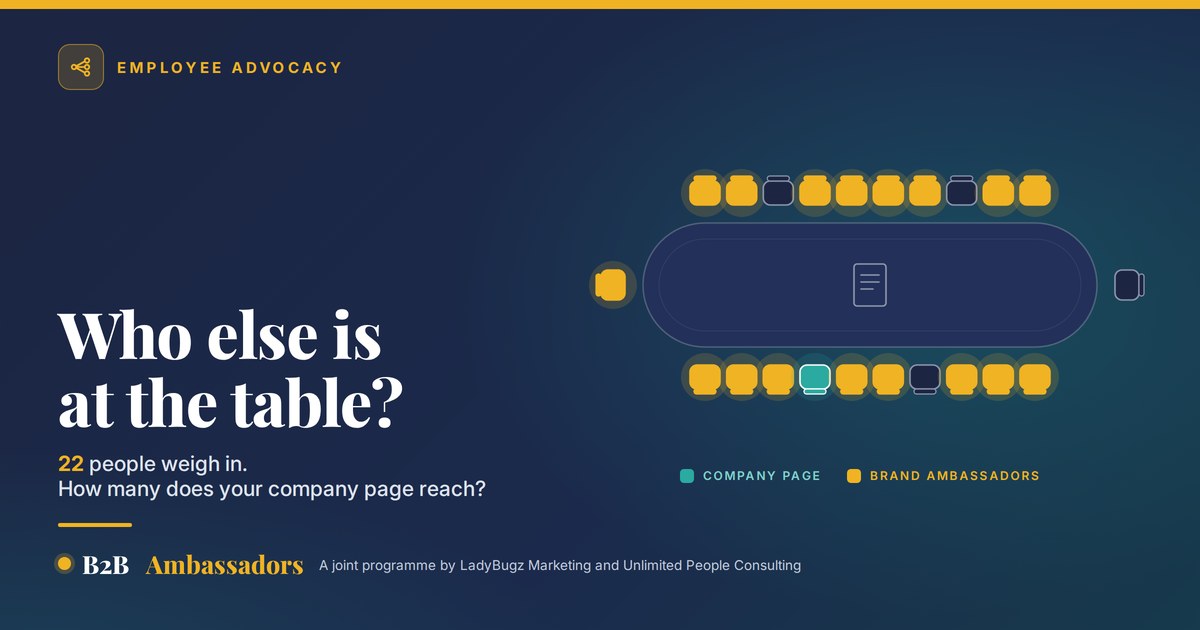
22 people weigh in on a B2B deal. How many does your company page reach?

22 people have a say. Your company page probably reaches very few of them.

Noleen Thompson · 4 November 2026

Somewhere inside your biggest open deal sits a finance manager you have never met. Next to them are an IT lead running a security review, an operations head who will live with whatever gets bought, and a procurement officer with a spreadsheet. Your sales team probably talks to two or three of them. Your company page speaks in one voice, mostly to the people who already follow it.

In October 2026, LinkedIn's marketing blog repeated a number for that crowd, which marketers call the buying group. In "From Buyer Signals to Pipeline", Vita Molis of LinkedIn wrote that "the average buying group spans 22 stakeholders across three or more departments", citing Forrester's Buyers' Journey Survey (2025). Forrester's own breakdown, published in February 2026, is 13 people inside the buyer's organisation and nine from outside it, with 73% of purchases involving three or more departments. We think most B2B (business-to-business) companies are still trying to reach that whole group with one voice.

Key insights

  • 22 people: Forrester counts 22 people in the average B2B buying decision, 13 inside the buyer's organisation and nine outside it (Buyers' Journey Survey 2025, repeated by LinkedIn in October 2026).
  • Breadth pays: deals where six or more contacts were engaged before sales logged them had win rates (the share of deals you close) about 17 percentage points higher than single-contact deals (Factors, vendor data, reported by LinkedIn, September 2026).
  • Leaders set the pace: only 6 to 7% of employees post on LinkedIn in an average month, and employee posting tends to follow leaders' posting (Tribal Impact, vendor study, July 2026).
  • Our view: a company page is rarely connected to all 22 people; a team of brand ambassadors, each with their own network, can reach far more of them early.
  • Pipeline over likes: LinkedIn advises measuring pipeline (live, qualified sales deals), not activity; we apply the same test to ambassadors.

What is a buying group, and why does its size matter?

A buying group is everyone who has a say in a purchase: the people who sign, whoever will use it day to day, the ones who check it, and anyone who can block it. Forrester finds several of them sit outside the buyer's business.

Size matters because each of them worries about something different. The CFO (chief financial officer) is thinking about payback. Whoever runs IT wants to know what might break. End users mostly want to know if Monday gets harder.

More people can also mean more friction. The same post cites Gartner (2025): "nearly three in four buying groups report unhealthy conflict before reaching a decision".

Why can't your company page reach the whole buying group?

A company page can't reach the whole buying group because it speaks in one voice, mostly to the people who already follow it. The procurement officer in your biggest deal probably isn't one of them.

Timing makes it harder. Dreamdata, an attribution software vendor, says 81% of the B2B buying journey is complete before a buyer engages a vendor directly, based on its own customer data (cited by LinkedIn, October 2026). If that holds, most of the group will have formed a view of you before your salesperson gets a meeting. A study by Factors, a LinkedIn Marketing Partner that sells attribution software, reported on LinkedIn's blog in September 2026, found that buyers' engagement on LinkedIn typically starts around 124 days before the deal appears in the seller's CRM, the system where sales logs its deals.

We would argue that view is shaped more by people than by logos, and LinkedIn's own B2B Institute gives employees a central role in an August 2026 post on its research, "The Credibility Code": "When employees share insights, experiences, and perspectives, they make expertise feel more authentic and more relatable." We explore why buyers believe your specialists in why your customers cannot see the value you deliver.

How do brand ambassadors reach the buying group before the first sales call?

Brand ambassadors reach the buying group early because each one carries your expertise into a different network, and those networks touch different people on the buyer's side. A brand ambassador is an employee who shares what they know, in their own voice, on their own LinkedIn profile. Doing this at scale, with support, is called employee advocacy.

The same Factors report, "From Benchmarks to Blueprints: The LinkedIn Revenue Engine for B2B", looked at more than 50,000 closed deals at over 100 B2B companies. Deals where six or more contacts were engaged before the deal was created in the CRM saw win rates about 17 percentage points higher than deals where only one contact was engaged. Deals that reached a mix of the buyer's end users, influencers (people who shape the decision without signing off on it) and technical evaluators did better still, by 22 points. It shows a link, not proof of cause.

That study is about LinkedIn marketing in general and does not mention employees. Using your own people to reach more of the buying group is our view at B2B Ambassadors. A company page or a single salesperson is rarely connected to all 22 people, inside and outside the buyer's business. A whole team can be.

The match-ups tend to look like this.

  • A solutions engineer on an integration that went wrong, and how they fixed it, is talking to the technical evaluator.
  • Your customer success team, on what week six of a rollout really feels like. End users notice.
  • When your managing director writes about where your industry is heading, the executive sponsor (the senior person who owns the decision) reads it.

Your leaders go first

Leaders appear to set the pace for employee advocacy: in one large vendor study, employee posting tended to follow leaders' posting. Tribal Impact, a consultancy that sells advocacy services, tracked 860 B2B companies over 40 months for its 2026 Employee Advocacy Behavioural Benchmark Study (July 2026). It found that "between 6 and 7% of employees post on LinkedIn in an average month". Senior leaders post about twice as often. Between 13 and 15% of CXO-level leaders (the top executive team, such as the chief executive and chief financial officer) post in a given month, down from 25% in early 2023.

Employee activity followed leadership activity, usually within two months, in 82% of the companies tracked. In 80% of companies, one month's activity from VPs (vice-presidents) and directors predicted the next month's employee activity. So your VPs and directors set the pace too, not only your CEO.

Noleen Thompson, co-founder of B2B Ambassadors, came to a similar point from the training side after meeting Sue Anderson of Unlimited People Consulting in November 2026:

"We realised that the challenge with sales is that leaders don't go on the same programmes to ensure they keep updated on trends and remind them about the basics. Great organisations have leaders who are always learning as well, and sharing what they know to improve their teams."

Both fit where we start anyway, with the person before the post, which is the thinking behind why brand ambassador programmes fail without self-awareness.

How do you measure brand ambassadors by pipeline, not likes?

To measure brand ambassadors by pipeline, track the target accounts (the companies you most want to win) that their content reaches, then check whether those accounts become real sales opportunities that move forward and close. Pipeline is the set of live, qualified deals your sales team is working on, with a value attached.

LinkedIn's October post has a section headed "Measure pipeline, not activity". In it, Ney Lins, VP Marketing at Rewind, describes what happens when marketing and sales share the same target: "all of a sudden we are all going after the same number."

Likes and impressions (the number of times a post is shown) tell you a post is landing, but nobody signs a contract because of a like. The better questions look more like these.

  • Which target accounts have people engaging with our ambassadors?
  • How many people from each account had we reached before the first sales call?
  • Did those accounts become opportunities, and did those deals move faster or close more often than the rest?

We haven't found an independent study that ties employee posts to revenue in a clean line, and we'd be wary of anyone who promises one. That's the reason to measure your own pipeline. Our Measurement Framework, on the resources page, is a practical place to start.

If we were across the table from you, we'd suggest one exercise. List everyone involved in your biggest open deal, inside and outside the buyer's business. Tick the ones your people are connected to on LinkedIn, then circle those who have seen anything useful from you lately. The gap between the list and the circles is where brand ambassadors earn their place.

Frequently asked questions

What is a buying group?

A buying group is everyone who has a say in a purchase: the people who sign, whoever will use it day to day, the ones who check it, and anyone who can block it. Forrester finds several of them sit outside the buyer's business.

Why can't a company page reach the whole buying group?

A company page can't reach the whole buying group because it speaks in one voice, mostly to the people who already follow it. The procurement officer in your biggest deal probably isn't one of them.

How do brand ambassadors reach the buying group before the first sales call?

Brand ambassadors reach the buying group early because each one carries your expertise into a different network, and those networks touch different people on the buyer's side. A brand ambassador is an employee who shares what they know, in their own voice, on their own LinkedIn profile.

How do you measure brand ambassadors by pipeline?

To measure brand ambassadors by pipeline, track the target accounts (the companies you most want to win) that their content reaches, then check whether those accounts become real sales opportunities that move forward and close. Pipeline is the set of live, qualified deals your sales team is working on, with a value attached.

Want your people in front of the whole buying group?

We help B2B teams turn in-house expertise into voices the buying group can find and trust.

Talk to us about a discovery call